
Cai Shi Fu · Kiln Fire Tender at the Decorative Brick Factory
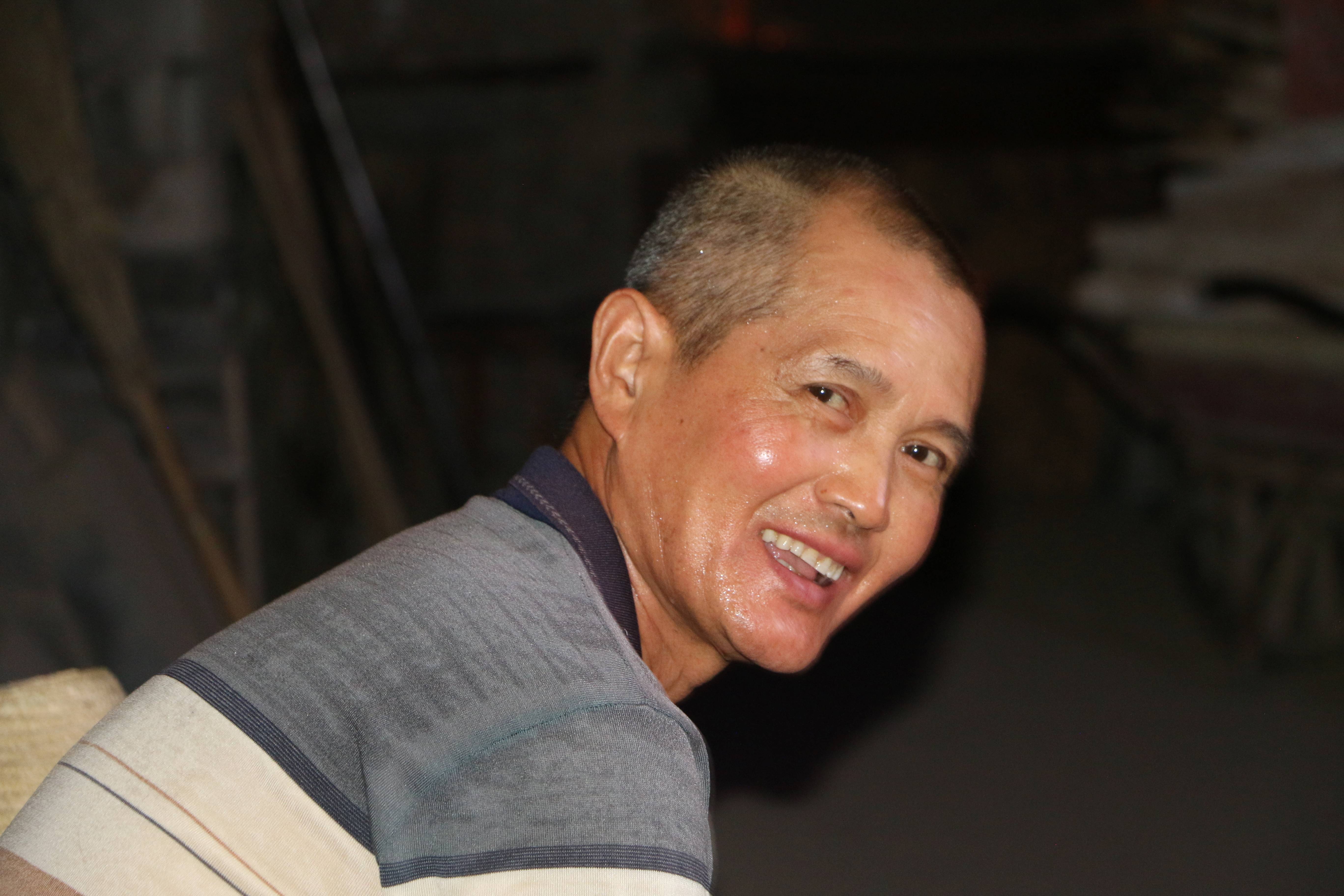
Cai Shi Fu · Kiln Fire Tender at the Decorative Brick Factory
Authorization · Authorized“"People my age—the next generation just can't do it. They don't fire kilns. Our generation is the last."”
Full transcript
《The Decorative Brick Factory: Interview with Master Cai》
Editorial note: Q = interviewer; Cai = Master Cai; Aside = bystander (Master Cai's second aunt, etc.). In editing, I've tried to keep the original wording and cut repetition and meaningless filler. Obvious transcription errors have been restored from context, e.g. “pesticide” = dragon kiln, “oil out/loading sheep” = unloading/loading the kiln, “slip drill/makeup/painting scroll” = decorative brick, “make medicine” = making kilns, etc.
Q: Let me note this down first—is it okay if I record and take photos?
Cai: Yeah, yeah, recording and photos are fine.
Q: What's your name?
Cai: Cai as in Jolin Tsai, Dao as in road, Shui as in mountains and water.
Q: Date of birth?
Cai: May 28, 1964.
Q: Are you from this town?
Cai: I'm from this town—Qinchi Town, Xingyuan Village, Xinyuan Taoyao Village. Chengshi Town, Xinyuan: xin as in Xinzhou, yuan as in New Year's Day. Xinyuan Taoyao Village, tao as in ceramics.
Q: How long have you been doing this?
Cai: Just here firing the kiln, this year makes five years. I've fired four full years. Five years firing here.
Q: What about other places?
Cai: Other places—wasn't that just working? I worked a few years here and there. I never fired kilns before. I only started firing when I came here. Locally, this is what we do—fire kilns.
Q: What did you do before?
Cai: Before, I was in Wuhu, Ma'anshan, Baimashan, Xinyang liquefied gas station, worked eight years. Not a formal job, just working. Five years ago I came here.
Q: How did you end up coming here?
Cai: We're locals. It's not that I knew it had opened and came. It opened in '19, started firing officially in '19, built the kiln in '18. They've been firing for seven years now. The first kiln was also fired by me. After that I didn't fire; I worked at the kiln factory up there. I worked at the tile factory up there for two years, then came back here. It's close to home. My wife's health isn't great, so being close is convenient for looking after her. I've just been firing here all along, never went anywhere else.
Q: You'd never fired before—how did you know how?
Cai: How would I not know? There are very few people around here who don't fire kilns. At our age, our grandparents fired kilns. Before, it wasn't this kind of kiln; it was bricks. We used to fire steel vats and clay pots. Around here, our ancestors did this. As for exactly when, it's recorded in the Jinxian gazetteer. At our age, locals basically all know how. The next generation can't do it. They don't fire kilns. Our generation is the last. Even people in their fifties are few.
Q: Why not let the next generation fire too?
Cai: The next generation—young people—firing this is too hard. How many of the next generation are willing? The pay is low and it's dirty. The next generation definitely won't do it.
Q: Besides you and your wife, who else is in the family now?
Cai: The kids are all married. My son and daughter are both married and not around us. At home it's just me and my wife. The children don't do this line. In our next generation, the number doing this is basically zero. In the whole town it's basically few—basically none. The craft is still there, but the next generation isn't. There's still one family in Xinyuan Village. The father is still there and has his son doing it, over in Simaqiao. Few people do it—maybe that's actually a good thing. But no, dragon kilns aren't allowed now.
Q: What's a dragon kiln?
Cai: You don't know dragon kilns? It's like a long dragon, firing from the bottom up, very long. You can see it on your phone. Dragon kilns aren't allowed to fire anymore—they can't meet environmental standards. They burn firewood and smoke. The old kiln site up there is still preserved. Ours isn't called a dragon kiln.
Q: What part are you responsible for?
Cai: Firing the kiln. We specifically fire. Firing means tending the fire—pull the damper, open the door, add firewood. There's a temperature gauge up there. There's also a master who watches the fire. We're responsible for adding wood.
Q: Is the fire-watcher hired from outside?
Cai: Fire-watching is a专门 person, hired from another province, from Jiangsu. We don't have anyone local yet. They work in 24-hour shifts so the fire doesn't go out. One kiln takes 27 or 28 days to fire. The fire-watcher doesn't need to stay here watching. Usually morning and evening—when it's light and when it's dark. During the day you can't see much; daytime fire-watching isn't accurate. Only when it's dark morning or evening can you see clearly. He only needs to come twice a day, not necessarily. Right after lighting, it's fine if he doesn't come for two or three days. At this stage now, he has to come every day—morning and evening.
Q: Does fire-watching mean looking at temperature?
Cai: It's looking at temperature. Too old won't do, too young won't do; too high won't do, too low won't do. If it's low, it comes out yellow. If it's high, it comes out overfired. This has a lot of technical skill. The pay is very high. He's hired from Jiangsu Province, salary around 100,000-plus a year. He comes once in the morning and once in the evening. Early and late stages, usually he comes every day or two. But he lives here. When there's nothing to do he's up there, sometimes comes by to hang out.
Q: What about your pay for firing?
Cai: We just fire and add wood. There's no real skill. Not much technical skill, but few people do it. The pay is low, young people don't want to do it—so they call us old people. They say eight hours, but it's split into two, six-hour shifts, three shifts rotating. You work six hours; each shift covers either the first half or second half of the night, or morning or afternoon. Three people rotate, six hours per rotation. When the time comes, you switch and the next shift takes over.
Q: What temperature is needed?
Cai: Specifically, usually around 870–880. There's another gauge top and bottom, always around 900, 950. This one is always around 870.
Q: What do you burn?
Cai: Furniture boards, offcuts from furniture factories. Waste repurposed.
Q: What do you think is the key to firing well?
Cai: It's hard to say exactly. One kiln is fired by three people. Adding more or less isn't fixed. Adding more doesn't necessarily mean more pay. Generally, at this stage, you add a furnace of wood within about 15 or 20 minutes. Those of us who fired dragon kilns can basically fire this kiln. At our age, very few haven't fired. From sixty up to seventy, in that middle range, very few can't fire. We locals can; outsiders can't.
Q: Does Siyiao Village next door also fire kilns?
Cai: Siyiao Village doesn't have this kind of kiln. This kiln only exists here. Siyiao fires the kind we used to.
Q: Are you tired after a day?
Cai: Of course I'm tired. Summer is definitely tiring, and hot. Most young people won't do it. It's mainly physical—backache, sore waist. At our age, doing this still burns some energy. We've only fired five or six years; haven't heard of occupational diseases. Burning wood isn't very polluting. People who can do it generally don't complain. Other seasons are okay; summer is the hard part. Summer lasts nearly four months. The temperature itself is 37–38°C; inside the kiln it's 70–80°C, outside at least 50°C. You go in, add some wood, come out drenched in sweat. Summer is the hardest. Winter is okay—winter is warm.
Q: Is this second aunt over seventy?
Aside: Seventy-one.
Q: She also works in Wuhu?
Aside: Huolonggang, 4,200–4,300 yuan.
Q: How much per shift for firing?
Cai: 105 yuan a shift. It's not based on how much you produce; fire six hours and it's 105. A month, usually you can work 40 shifts, 4,200–4,300 yuan. No young people do it. The longer you fire, the more you fire, there's no raise. Nothing. No social insurance. It's just laborer, temp-worker treatment. There's no slow or busy season. From after New Year, the first month, to the twelfth month—11 months. One month off for New Year. Three people, six hours: 5 to 11, 11 to 5. Four shifts, 24 hours. It burns a big fire all along; by our stage it's a small fire. The stuff inside slowly moves over from that side.
Q: Do you come in the afternoon to load the kiln?
Cai: Around 2 in the afternoon; a little after 12 they come. Fill this kiln up, get the holes below loaded, there's also a door up top. After loading, light the fire, put the stuff in. Come in the afternoon to load. You can film from above.
Q: How much is the wood?
Cai: Wood is about 500 yuan a ton. All offcuts from furniture factories. Seems like factories run by Zhejiang people over in Guangde; some is even shipped from Zhejiang. It's not all wood; some is like plywood—furniture board offcuts. Nothing wasted.
Q: Which process in the whole factory is the hardest?
Cai: The hardest are firing, loading, and unloading—just those three. Loading and unloading: you load it in, and after it's fired and cooled you pull it out. The raw bricks are ordered from outside. We don't make raw bricks locally; the local clay isn't good. The raw bricks are hauled over from Zhejiang. The finished products include decorative bricks—Boss Wang. He does the drawings himself; Boss Wang and them hire people to mix their own. Most people can't get this technique. Decorative bricks, they're not slippery—there's a factory above that makes decorative bricks. The decorative bricks are up there. Loading, unloading, firing—in terms of physical labor, unloading and loading are the hardest. They usually hire Guizhou people. The Guizhou people have been working here long-term, since the factory was built—six or seven years. They come at 12. Outsiders bring their families. Three families, six people, kids and all here; the kids go to school here. They go home for New Year, take the kids back during winter vacation, bring them back when school starts in the first month. Their pay is a bit higher, and it's hard work. At our age we can't keep up. They only work twenty-some days a month. The boss tells them the details; we can't figure it out. Anyway, their pay is definitely higher than ours.
Q: The most skilled part is fire-watching?
Cai: The firers just need to take the fire from small to big. If you don't rush it into a big fire, it won't spoil. Fire-watching—either it's overfired, underfired, too high, or too low. They even hired an outsider for this; outsiders are very good at watching. The people who used to fire bricks, golden bricks, were in Jiangsu and Zhejiang; the place of origin is Suzhou, Jiangsu. Golden bricks are the ones used in the old Forbidden City, the ones used on the Great Wall. They weren't fired in Beijing; they were fired over in Suzhou, Jiangsu. The bricks for the Great Wall had names on them—which family fired them. The big bricks here have names; small bricks don't, decorative bricks don't. We can't figure out what names are written on the big bricks. Anyway, they write the boss's name, write some factory or other, antique-style. In plain terms, it's faking it. Everyone does it now—antique style. The big ones are 80×80, one meter by one meter, several hundred jin per piece. Moving them is easier now—there are electric carts with batteries, push them forward, saves a lot of effort. Loading takes 3 days, unloading takes 3 days, 6 days. Once loaded, the kiln can't be empty. As soon as it's pulled out, it's loaded again. Then it's not their concern; everyone rests, can rest at home. Their pay is relatively okay; otherwise a family couldn't survive. They rent housing; the factory rents it for them.
Q: Do young people from Guizhou come too?
Cai: The three women are tougher than the men. Three families, three men and three women. Our local men can't outwork those women. Those women can take hardship and they're young. Over there, living conditions and environment are relatively more practical. They were in Guangde before. Jiangsu and Zhejiang wouldn't let them fire, so they went to Guangde. After a few years Guangde wouldn't let them fire either, so they moved here. This is very likely the last stop. If this place won't let them fire either—does this kind of kiln pollute? This kind is okay. In past years they wouldn't let you burn straw in the fields. Before, firing dragon kilns was fine; people burned plant ash everywhere. Now dragon kilns aren't allowed. Our family's dragon kiln—at the very least it could employ us locals. I'm from Jing County, working in Wuhu. When I was a kid, Jing County's air was better than now. You could burn anything, and the air was still better. Now there are more factories—not this kind of thing, probably chemical. How much pollution do we make? It's such a hassle now. Today environmental protection comes, tomorrow environmental protection comes, doing tests, doing this and that—annoying as hell. The boss is going crazy too. It rained the day before yesterday, and environmental protection still came to test. The boss doesn't have it easy either. They invite them to dinner. They want to do it, but now obviously they don't dare—you invite them to eat and they won't.
Q: What are the processes in this factory?
Cai: Besides loading, unloading, and firing, those are the three processes, plus one fire-watching master. Our whole factory is 14 people: 6 firers, 6 helping unload, one fire-watcher, and one No. 2 boss, basically the person in charge. The legal representative is Boss Wang. This factory belongs to Boss Wang, and Boss Wang transferred it down to a Guangde guy. The kilns on this side were brought in by the Guangde boss. That kiln over there is fired by my aunt; it was brought in by Wang Dong—different boss again. This factory's investment this year isn't flashy, but for a small-scale operation it's okay. One kiln has several hundred thousand in it. The land isn't his; it should have been bought. The original buildings were also built by Boss Wang. The outside buildings were all built by Boss Wang. Not finished yet. Business should be okay—fires all year, never rests. From lighting in the first month to the twelfth month, one month off a year, work 11 months.
Q: How long do you think you can keep working?
Cai: This requires good health. Like my aunt—she can still work two or three years, she's healthy; seventy-two, seventy-three, seventy-four should be fine. Overall, if it doesn't burn too much energy it's better. It's just summer heat, and staying up late. Staying up at night takes a toll. You rotate every day, changing shifts every day. Today you're on afternoon shift; tonight you rest 12 hours; tomorrow morning at 5 you have to come back and work until noon. Sometimes you sleep early, sometimes late—no routine. A lot of people can't adjust. It's not about money; they just can't adjust. No regularity. If you can lie down and fall asleep, that's good. Sometimes you work the first half of the night—like last night, 5 p.m. to 11 p.m.—then you go home and sleep the second half. Tomorrow night is the big night shift. One afternoon shift followed by a big night shift, then the day after is morning shift, then the day after that big night shift. Morning shift ends at noon, go home and rest 12 hours. Mainly it's irregular. People who can't adjust can't get up at those times. Outside temperature is okay; turn on an electric fan and it's okay. The hardest is still unloading. You have to stay right by the fire, in the kiln tunnel, take the stuff off the conveyor. After the fire stops, after it's out, you still douse with water. After dousing there's still heat. After dousing, open the kiln door, blow with electric fans for 5 days, still heat. After stopping 5 days, unloading 3 days, it's been 8 or 9 days, and there's still hot air inside. They set up fans on top, a blower on the kiln roof blowing down. It's purely people carrying it out, putting it on the conveyor, then out, then onto electric carts.
Q: What do your children do?
Cai: The kids are all working. The grandkids are still in school. I have a little granddaughter, 13, 12, going into sixth grade in the second half of the year. Exams on the 30th. They're in Xuancheng—my son and daughter-in-law are in Xuancheng, they live there. If you don't sell the house, can't the kid study? Buy a little house in Xuancheng. They care about the kid's education. In our rural areas, which family doesn't? One kid—which family doesn't care? They care, but conditions are limited. Rural people talking fake stuff is useless. What can you do after school these days? The last two years jobs aren't easy to find; college students can't find them easily. Overall it's not good. You're a teacher, you know better than us. Before, jobs were easy to find; now they're not so easy. One family, one kid—what can they do? Especially a little girl like ours—what can she do? I want her, whatever else, whether working or whatever, to have it a bit easier, not burn too much energy, not do heavy physical work. Best to get a stable job. But then again, that's not up to us. Kids need talent for studying too. If she gets into Anhui Normal University, then being a teacher is still okay. Getting into Anhui Normal is possible; you need about 570–580 on the liberal arts college entrance exam. We work in Wuhu, often go to the gate of Anhui Normal. Before the pandemic you could go in; during the pandemic they wouldn't let you. I went in '08, came back in '15, stayed there 8 years. Eight years in Xuzhou. After work at night there's nothing to do. Working at the liquefied gas station was easy. Off at 5 p.m., after dinner go play by the river.
Q: I've taken up your time. Let me pay you a little something.
Cai: Nonsense. It's your home—no, no such thing. Pay 50 yuan? No, no.
This answer was generated by AI. The content is for reference only. Please verify carefully.
Original Chinese transcript
《花砖厂 蔡师傅访谈录》
整理说明:问=采访者;蔡=蔡师傅;旁=旁人(蔡师傅二姑姑等)。整理时尽量保留原话,删除重复、无意义口语;对录音中明显识别错误处,按上下文恢复,如“农药”=龙窑,“出油/装羊”=出窑/装窑,“滑钻/化妆/画卷”=花砖,“做药”=做窑等。
问:先记一下,要录音、拍照没事吧?
蔡:对对对,录音拍照没事。
问:您叫什么名字?
蔡:蔡依林的蔡,道路的道,山水的水。
问:出生年月?
蔡:1964年,5月28日。
问:您是本镇人?
蔡:本镇人,就是秦池镇杏园村,信源陶窑村。城市镇,信源,信州的信,元旦的元。信源陶窑村,陶是陶瓷的陶。
问:您做这一行做了多长时间?
蔡:我光在这里烧窑,今年5年了,烧了4整年。在这烧窑5年。
问:别的地方呢?
蔡:别的地方不是打工吗?到处这里打几年,那里打几年。以前都不烧窑,到这来才开始烧窑。我们本地就是烧窑。
问:原来干什么?
蔡:原来在芜湖、马鞍山,白马山,信阳液化气站,干了8年。不是正式工作,也是打工。五年前到这个地方。
问:怎么想到来这里?
蔡:我们是本地人。不是晓得它开了就来。它19年开始开的,19年正式烧窑,18年建的窑。他烧窑已经7个年头了。第一个窑也是我烧的,烧了以后我就没有烧,在上面窑厂干事。在上面轮瓦厂干了两年,然后再回来这里。离家近,因为家属身体不太好,离家近照顾方便。姑娘我就一直在这烧窑,没到其他地方去过。
问:以前没烧过,怎么就会烧?
蔡:怎么不会烧?我们这地方不烧窑的人很少。像我们这年龄,祖辈就是烧窑的。原先不是烧这样窑,是烧砖。我们原先是烧钢坛瓦罐。我们这地方祖辈就是搞这个。具体什么时候,进贤志上有记载。像我们这个年龄,本地人基本上都会。下一辈就不行了,没有烧窑。我们这一代是最后一代。五十几岁的都少数了。
问:为什么不让下一代也烧?
蔡:下一代年轻人烧这个多辛苦,有几个下一代愿意搞?工资又低又脏。下一代肯定干不了。
问:家里现在除了您和老伴,还有什么人?
蔡:小家伙都成家了,儿子女儿都成家,都不在我们身边。家里就我和老伴两个。小孩子没有做这一行。我们下一辈做这行的几乎来讲是0。整个镇子基本上都少,基本上没有。手艺还有,但下一辈没有了。新园村还有一家,他爸爸在,叫他儿子在做,在司马桥那地方。做的人少,搞不好还是蛮好的事。不行,现在龙窑不给做。
问:什么叫龙窑?
蔡:龙窑你们不知道?就像长龙一样,从下面往上面烧,好长的。手机上也能看到。龙窑不给烧了,环保达不到,要烧柴火冒烟。上面古窑址还保持在。我们这个不叫龙窑。
问:您负责哪一道事情?
蔡:就是烧窑。我们专门烧窑。烧窑就是把火,把马拉一下子,把门打开,把柴火加进去。上面有温度表。另外专门有师傅看火。我们负责加柴。
问:看火是外面请的?
蔡:看火专门有人,在外省请来,在江苏请来。我们本地还没有。24小时轮班,不让火熄掉。一窑要烧二十七八天。看火的师傅不需要在这里看,一般早上和晚上,天明亮和天黑。白天看不出来多大名堂,白天看火看不准,早晚黑了才看得清楚。他一天来两次就行,不一定。期限点火的话,两三天不来也不要紧。到现在这种时候,每天都要来,早上要来,晚上要来。
问:看火是看温度吗?
蔡:就是看温度。老了不行,嫩了不行;高了不行,低了不行。低了他就钻出来黄颜色,高了出来就老掉了。这个很有技术含量,工资待遇都相当高。在江苏省请来的,年薪大概十几万块钱。一天就来早一次晚一次。后期前期一般天把两天来。不过他住这里,没事就在上面,有时来玩一下。
问:那您烧窑的工资呢?
蔡:我们就是烧窑加柴的,没有什么技术。技术含量不高,不过干的人也少。工资低,年轻人不愿意干,这叫我们老年人。讲是8小时,分成两下干,6小时一班,三班一转。上6个小时,每个班都能上到上半夜下半夜,上午下午。3个人轮着转,6个小时一转,到时候换,下一班来接。
问:温度要多少?
蔡:具体一般就在870—880,下面上面还有个表,总在900、950左右。这个总在870。
问:烧柴烧什么?
蔡:就是家具板,家具厂的下脚料,废物利用。
问:您觉得烧好关键在哪里?
蔡:具体讲也讲不清楚。一个窑三个人烧。加多加少不一定,加多也不一定涨钱。一般到现在这种程度,大约15分钟、20分钟以内加一炉子柴。我们烧龙窑的烧这个窑基本上都会。像我们这个年龄段,没有烧过窑的很少。六十岁往上到70岁,中间段不会烧的基本上很少。我们当地人,外地人不行。
问:旁边四瑶村也烧窑?
蔡:四瑶村没有这个窑。这个窑就这地方有。四瑶就是烧的跟我们那个。
问:您一天下来累不累?
蔡:肯定累,夏天肯定累,又热。一般年轻人都不干。主要就是体力,腰酸背痛。像我们这个年龄段干这个还当消耗一点体力。我们才烧五六年,没听讲有职业病。烧柴火污染不太大。能干的人一般来讲不挑不妥。别的季节还好,就夏天难。夏天将近4个月,本身温度三十七八度,烧窑里面七八十度,外面最少50度。进去加一哈柴出来一头汗。主要夏天难熬,冬天还好,冬天暖和。
问:这位二姑姑有70多岁了吗?
旁:71了。
问:也在芜湖干?
旁:火龙岗,四千二三百块钱。
问:烧窑工资多少一个班?
蔡:105块钱一个班。不是按做出来多少东西,烧6个小时就105块钱。一个月一般能上40个班,四千二三百块钱。年轻人没人干。烧的年数越长也不加钱,什么都没有,社保没有,就是打工的、临时工待遇。没有淡季旺季,从过了年正月开始到腊月,11个月。过年放一个月假。三个人6个小时,5点到11点,11点到下午5点,分四班,24小时。一直烧大火,烧到我们那种程度就是小火了。里面的东西从那边慢慢转过来。
问:下午来装窑?
蔡:下午2点左右,12点多一点就来了。把这个窑装满了,下面洞装好,上面还有个门,装好了以后点火,东西放进去。下午来装窑,从上面拍。
问:柴料多少钱?
蔡:柴料大概500块钱一吨。全部是家具厂下脚料,好像是广德那边浙江人办的厂,有的还是浙江过来的。也不完全是木材,有的是三合板一样,就是家具板下脚料。这个没有浪费。
问:整个厂哪个工序最辛苦?
蔡:最辛苦就是烧窑和装窑、出窑,就这三个工序。装窑出窑,把它装进去,烧好了冷却了再抽出来。土胚是在外面叫的,我们当地不制土胚,当地泥巴不行。土胚在浙江那边拉过来。成品有花砖,王老板。图纸他自己搞,请王老板他们请人自己配置。他这个技术一般人搞不到。花砖他不滑,他上面有个厂做花砖,花砖在上面。装窑出窑烧窑,按体力来讲,出窑和装窑最辛苦。他们一般找贵州人。贵州的在这长期干,从厂建起来就他们,六七年了。他们12点就过来。外地人带家庭过来,三家人家,6个人,带小孩全部在这,小孩在这上学。过年回家,寒假带回去,正月开学再带来。他们工资高一点,辛苦。像我们这么大年龄干不下来。他们一个月只能干二十几天事,具体老板跟他们说,我们搞不清楚,反正比我们工资肯定高。
问:最有含量的是看火?
蔡:烧的人只要火从小到大烧,不煮上来烧大火,它不得坏。看火,要么老了,要么嫩了,要么高了,要么低了。这个还搞个外地人,外地人很会看。原先烧砖、烧金砖的不就在江苏浙江,起源地不就是江苏苏州。金砖就是老早故宫上面用的那些,长城上面用的那些砖。不是在北京烧的,是在江苏苏州那边。造长城那些砖上面都有姓名,哪家烧的。这上面大砖有名字,小砖没有,花砖没有。大砖写什么名字我们搞不清楚,反正写他们老板的,写一个什么什么厂,仿古。通俗一点就是造假。现在都这样,仿古。大的80×80、一米乘一米,几百斤一块,搬起来现在条件好,有电动推车,带蓄电池,往前推,省力不少。装窑得3天,出窑得3天,6天。装好了,这个窑不能空,刚推出来马上就装起来,然后没他的事,大家休息,可以在家休息。他们工资相对来讲还好,不然一家人生活不能维持。他们租房子,厂里给他租。
问:贵州那边年轻人也来?
蔡:三个女的比男的还厉害。三家人家,三个男三个女。我们当地男的也干不过她们那女的。那个女的能吃苦也年轻。他们那边生活条件、环境相对来讲要实惠。他们原先在广德,从江苏浙江那边不给烧,到广德,广德烧几年也不给烧,再搞到这个地方来烧。这很可能就是最后一站。这地方再不给烧,这种窑也有污染吗?这种窑还好。往年田间地头秸秆不给烧,以前烧龙窑不要紧,草木灰到处烧。现在不可以烧龙窑。我们家龙窑,最起码也能就业我们当地人。我是泾县人,在芜湖上班。我小时候泾县空气比现在好,什么都能烧,空气还好些。现在厂房多了,不是这种东西,估计是化工。像我们这个有多大污染?现在麻烦得很,今天环保来,明天环保来,搞测试,搞这样搞那样,烦死。老板头也搞大。前天下雨,环保还来搞检测。老板也不容易。请他吃饭,人家想做,现在明的人家也不敢那个,你请他吃他也不吃。
问:这个厂工序?
蔡:除了装窑出窑烧窑,就这三样工序,然后看火一个师傅。总共我们厂就14个人:6个烧窑的,6个帮着出窑的,一个看火师傅,一个2号老板,等于负责人。厂法人代表是王总,这个厂子是汪总的,汪总下来再转让给一个广德佬。这边几个窑是广德老板进的,那边一个窑是我姑姑烧的,是汪东进的,还不一样老板。这个厂今年投资也不显眼,小规模来讲也算可以。一个窑就是几十万在里面。地皮不是他的,应该是买的。原来房子也是王总建的。外面房子都是王总建的。还没搞好。生意应该还好,全年都烧,没歇过。从正月里点火到腊月,一年休息一个月,上11个月。
问:您觉得能干到多少岁?
蔡:这个要体质好。像我姑姑,两三年能干,体质好,七十二三岁、七十三四岁应该。总归来讲,不消耗体力要好一点,就是夏天热,另外熬夜。晚上熬夜有点伤人。一天轮,每天都换着轮。今天下午班,今天晚上休息12个小时,明天早上5点又要来接,上到明天中午。有时候早睡,有时候晚睡,没规律。这个有多少人不适应,不是钱的事,不适应。没有规律性。躺下来就能睡就好。有时上半夜来上班,像昨天晚上上半夜,下午5点到晚上11点,下了下半夜在家睡觉。明天晚上大夜班。一个下午班接个大夜班,明天就是早班,后天就是大夜班。早班到中午回去休息12个小时。主要不规律,不适应的人到那时候起不来。外面温度还行,开个电风扇也还行。最辛苦还是出窑,他要整靠着火,在窑洞里把东西从输送带放下来。火停掉了,熄掉了还打水。打完水温度还有,打完水把窑门打开,电风扇吹5天,还有温度。停了5天,出了3天,干了8天、9天了,现在里面还有空气,上面还搭电扇,窑顶上搭鼓风机往下面鼓。纯粹靠人搬出来,放输送带上面出来,出来再放到电动车上。
问:家里孩子做什么?
蔡:小家伙都在打工。孙子辈还在读书。我家一个小孙女,13岁,12岁,下半年升六年级。30号考试。在宣城,儿子媳妇在宣城,他们就住宣城。不卖房子不能小佳读书?在宣城买点房子。对小孩念书重视,像我们农村哪个家不重视?这一个小孩,哪家不重视?重视,但条件有限。农村人讲虚假的没用。现在上学出来能干什么?这两年工作不太好找,大学生不好找。总体来讲都不好了。你当老师比我们最清楚。以前工作好找,现在不是太好找。一家一户自己一个小家伙,能搞什么东西。尤其像我们家小女孩子,她能搞什么东西。想她以后不管别的什么,不管是打工搞什么,只能轻巧一点,不要消耗太大体力,不要做重体力事情。最好搞个稳定工作。这个话讲回来也不是我们的事。小家伙念书也要天赋。上安师大,然后当老师还是可以。上安师大可以,需要高考文科大概考五百七八十分。我们在芜湖上班,经常到安师大学校门口去。疫情之前可以进,疫情就不给进。我08年去的,15年回来的,在那里待了8年。徐州待了8年。晚上下了班没事,在液化气站上班轻松,晚上5点钟下班,吃了晚饭到河边去玩。
问:我耽误你时间了,给你付点报酬吧。
蔡:瞎扯,你家的不,不存在。付50块钱?不存在不存在。
Machine translated, corrections welcome