
Wang Shi Fu (plus two anonymous others) · Water-Basin Workers at the Xuan Brush Factory
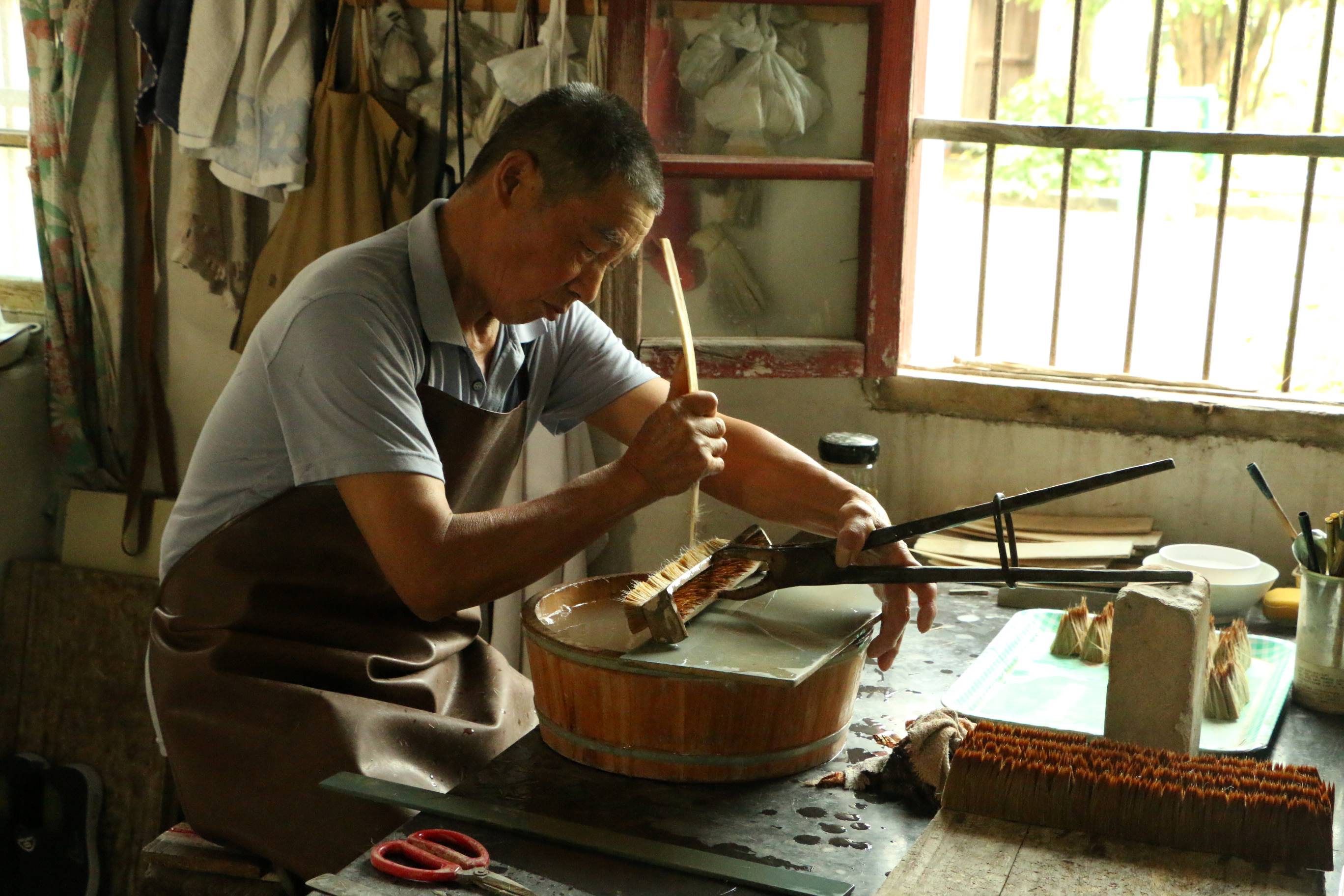
Wang Shi Fu (plus two anonymous others) · Water-Basin Workers at the Xuan Brush Factory
Authorization · Authorized“In winter, when others were warming themselves by the fire, we were still working away in cold water. In summer, this part"—he gestured to his hands—"would rot.”
Full transcript
《Xuan Brush Factory: Interview with Master Wang, Water-Basin Worker》
Editorial note: Q = interviewer; Wang = Master Wang; Aside = bystander interjection. In editing, I've tried to keep the original wording and cut repetition and meaningless filler.
Q: What kind of hair is this?
Wang: This is wool, pure wool, and pig bristle.
Q: Wool and pig bristle?
Wang: Right, this is fine-tip hair.
Q: What's the standard for doing this well?
Wang: Doing it well means mixing it evenly. Once it's even, the brush won't write unevenly; each brush won't have a crooked tip.
《Xuan Brush Factory: Interview with Master Wang, Water-Basin Worker》
Editorial note: Q = interviewer; Wang = Master Wang; Anon = anonymous interjection. In editing, I have tried to keep the original wording and cut repetition and meaningless filler.
Q: What kind of hair is this?
Wang: This is wool, pure wool, and pig bristle.
Q: Wool and pig bristle?
Wang: Right, this is fine-tip hair.
Q: What's the standard for doing this well?
Wang: Doing it well means mixing it evenly. Once it's even, the brush won't write unevenly; each brush won't have a crooked tip.
Q: What's your surname, Master?
Wang: Wang. Wang with the three-dot water radical.
Q: What year were you born?
Wang: '54.
Q: Are you from Jing County?
Wang: From Jing County, from Huangcun.
Q: How many years have you been doing this?
Wang: I entered the factory in '80. Over 40 years.
Q: You started as an apprentice, right? How many years did you learn?
Wang: I apprenticed for two years. It took about three years before I could officially do it independently.
Q: Does anyone else in your family do this?
Wang: My wife does brush trimming, up front. The kids don't. They quit; they're working elsewhere.
Q: Your skill is so good—you didn't pass it on to them?
Wang: They won't do it. They can't sit still, sitting here all day. They won't. I once thought about bringing my son in to learn, but it's not that simple. Not now. Society's different.
Q: Compared with a lot of打工 jobs, this isn't physical labor. It doesn't look like that kind of physical work.
Wang: This takes physical labor too. It does. Washing—the later part, applying wool, the cloth for applying wool, removing grease, combing out all the fine hair—that's more... The clips for the wool, the clips are heavy too. This comb, these clips take strength. Without strength, the clips are too heavy to move.
Q: After a day's work, is it your arms and hands that get tired, or what?
Wang: It's the arms. Both arms get tired, quite tired. It feels like you can't stop. My cervical spine hurts too, from sitting so long.
Q: Winter or summer—which season is better for doing this?
Wang: Winter, spring, summer, autumn—now is the best time to do it. Now it's neither cold nor hot. Summer's too hot, and the wool rots. Winter's definitely cold; you can't heat it, because heating singes off the tips.
Q: You all do it yourselves now, and don't take apprentices?
Wang: Nobody takes apprentices. See if the boss's daughter takes one. That's the boss's daughter, teaching her.
Q: As an apprentice you must earn less, then gradually more. Is it piecework, more work more pay?
Wang: More work, more pay. How much is one head worth? Like this, one yuan twenty. A month I make about 3,000, because I can only do so many. I can do 3,000 a month, make 3,000 yuan. Sundays off.
Q: Can you listen to music or chat while working?
Wang: That won't do. Can't listen to music—it affects it. Every day doing it, why can't you listen to music? Listening to opera, music, songs, talking—all okay. But having the TV on won't do. Your eyes can't look; once in a while you might glance, when tired you might glance. We can chat and talk here. Listen to the radio? The boss took the radios away.
Q: Why can't you listen to the radio?
Anon: You can listen on your phone, but not the radio. When we were apprentices, when they were young—what master was like that? Back then we listened to the radio, and the boss took it away. If you came and we were dead into listening to music, wouldn't that be rude? That won't do. Back then it was ten-some yuan a month, and a radio cost forty or fifty yuan—half a year's wages. When it was four mao a day, buying a radio cost half a year's wages. Masters were fierce back then. The master had the final say. Masters were really fierce; he wouldn't let you listen to the radio.
Q: Is there waste in doing this?
Wang: Yes. When does it get wasted? If it's wasted, then the whole basin is wasted—the combed-out hair, once combed out, can't be used again. Waste is a big deal.
Q: Is there any other use for the combed-out stuff?
Wang: No use. It's garbage.
Q: Does the amount of waste have to do with skill?
Wang: Not that. The hair in here, no matter what kind, once the comb goes through, some is going to fall out. You have to comb out the curly hair, deliberately comb that hair out, to mix it—it has to mix evenly.
Q: Your hands are in water for so long?
Wang: My hands are deformed. This comb pricks and combs all day. This is a small one; I also do the big ones, same way.
Q: I thought it was from soaking in water—it's from the motion?
Wang: Now the weather isn't very cold. In winter before, in the coldest days, it could freeze you to death, and you still had to be in this water. Now the temperature is higher, and winters aren't very cold—not tens of degrees below zero. Before, in winter, we all got chilblains. When I was a kid, I felt winter was chilblains. Before, we were in the water; in winter, others were by the fire, and we were still working in cold water. In summer, this part—he pointed to his hands—would rot, decay, rotting in the water every day.
Q: Why does it rot in summer?
Anon: It's soaking in water. This water is limewater. The hair needs its grease removed; you put it in limewater to cure. The hair must be soaked in limewater—it has grease—to sterilize and soften. The temperature now is still fairly high. It's not very cold now.
Q: You should be able to get some air conditioning in the frozen section?
Wang: Air conditioning won't work. This building is too big. That brush-trimming section inside—fifty-some years, been working fifty-some years.
Q: Which process in the whole thing is the hardest?
Wang: Ours. The water basin is the hardest. It's also the most skilled. Brush trimming is a bit better than this. Go look up front—brush trimming is easier.
Q: If you could switch jobs, would you be willing to trade with him?
Wang: They won't let you switch. Even if you want to, they won't let you. You want to switch to another job, you'd have to apprentice for years again. When you enter the factory, the factory director arranges it—wherever there's a shortage in a process, that's where you go. You don't choose. I chose that first, but no. Now that you know, if you had to do it again, which would you want? Trimming is fast, trimming is good—I'd want trimming. But the boss says ours has the most skill. Back when we entered, the director assigned you to the water basin, him to brush trimming. Three water-basin workers to one trimmer—that was the rule.
Q: Does anyone want to do your job?
Wang: Who'd want to? Doing this all day, you can't take it. Back in '80 when we entered, it was through connections and back doors—cadre's kids and all. To tell you the truth, the price, the pay is too low. Too low. It looks like sitting, but it's very tiring, sitting here all day.
Q: How many hours do you work?
Wang: Eight or nine hours. Now we have to be here around 7. We come at 7. We come a bit early, leave a bit late.
Q: Is it mainly your arms?
Wang: Mainly the arms, both arms. Holding these iron clips, this hand has to feed. One or two days doesn't matter, but year in, year out. We've been doing this forty-some years—soon fifty.
Q: How long do you plan to keep working?
Wang: Day by day. Really, your hands and feet have to be good, nimble, and your eyes good. To do this, your health has to be good. Even if you're worn out, you can still work; if your health is bad, you can't sit still. We're all over seventy.
Q: Doing this, don't you think the brushes you make are good?
Wang: If you make them yourself, you don't think they're good? Then you'd be a fool. Who says their own work isn't good? Because when we entered the factory, forty-some years ago, the old masters taught us. To this day we follow those principles. We do it slowly, slowly, following that order. Every month we do it well, all the same.
Q: Does the boss inspect?
Wang: He inspects. When you finish a brush, you feel happy seeing it. The boss's daughter checks it; if she looks at it and says okay, it's okay. For us, we just—
Q: Do you buy these brushes yourselves? Does your family use them for writing?
Wang: We're not educated; we don't write.
Anon: The kids practice calligraphy—can use this paper, and buy this brush?
Wang: They don't buy. There's cost. He made it for you, you got wages—you don't buy; he gives you brushes. Over at Huzhou brushes, the Zhejiang ones—Zhejiang brushes seem a bit cheaper than ours. But it's not the same. Our quality—the lamb wool—we use all top-grade wool. The cost is different, so it can't be the same. They say Jiangxi is cheap. After buying from Jiangxi, before it's even washed, it sheds hair in two months. Then they come back to our factory to buy. My old teacher—I brought him two Jinxing Xuan brushes twice. After that, whenever he wrote, he asked me to buy him these brushes. You all—we do the lining underneath. You can't see any of it. The lining underneath, that membrane—all pig bristle. The bottom is all pig bristle. After you comb it, you can't see it; as long as it's even, it's fine. The top and bottom are all synthetic hair; outside they cover it with a layer of white. The 5,000 we make are all the same. After trimming, they're put out in the shed to dry, and they're exactly identical. Our tips and Jiangxi tips and other tips differ by dozens of times. This pig bristle and synthetic hair—both are flat filaments, but their price differs by dozens of times. Just the raw material price differs by dozens of times. So people who don't understand don't understand. Many people in our factory come to our factory to buy. Also, the fried cake can warp. We fry with a paste beforehand. The ones bought outside are neither dry nor wet—that's the down core—so it has to be tied tighter. For example, if it's not dry and you tie it, if our brush has to be tied dry before taking it, then it won't do—it gets small, the size shrinks. That cake won't dry in the sun; we have to dry it several times, fry it bone-dry. Their cake is half-dry, aired a bit, then fried. It's not big. Once it touches water, once it touches paste, once it's fired, it burns away. Traditional craft follows tradition, passed down from before, not changed at all.
Q: So the higher price for these brushes makes sense?
Wang: The ingredients are different. Our ingredients are expensive. The cost of wool has gone up. Different. When he buys, he's been buying on account from the store, right? He just buys from the store. That's the cost.
Q: You'd start your kid practicing calligraphy with such good brushes?
Anon: Buy a bigger one. Start writing bigger—nine-grid, ten-grid, that diameter. Once they can write, then write smaller. See, when you start writing, when you need to write, if you don't use a bigger brush, like a large regular script brush. Small regular script won't do. Once they learn small regular script, then they write like that. That's how it is.
Q: I feel machines absolutely can't do this?
Wang: Machines can't. Should be impossible. Machines can't. Before, no matter how they researched, it wouldn't work. Can't use machines. Machines mess up applying hair, scrape the hair bad.
Q: So you can't call this just打工. This counts as a craft.
Anon: A craft is still打工. What's the use of a craft? Day after day, never stopping. Here we work from morning to night, and it's only two or three thousand yuan. Who'd do it? You wouldn't do it. Two thousand-some, two or three thousand—you wouldn't do it.
Q: You do it to be close to home?
Wang: No more going out. Nobody lives here now. If we don't do this factory at noon, if we don't, who'll do it?
Anon: Gone. No one does it. Now no one does it. Finding a master later will be hard. Where are the masters? The old masters—batch after batch, they're over seventy. Can they do it? They can't. Our batch—of our batch, I'm the only one left here. I'm over fifty, and everyone's gone. Who'd do it? They work together and leave together. Who'd do it for this pay? The pay is too low.
Q: Then what are you doing it for?
Wang: To put it plainly, for money. Earn a little, be a bit happier. That's how it is. Why does he? You earn a little today, give the kid a bit, send me some—that's the idea. For the kids. If you give it to the kids, you still have to ask them, beg them for food. Better to earn a little yourself. Earn a bit and spend it yourself. If you're healthy today and can work, but tomorrow you're not and can't—then you're finished.
Q: After all these years you should have saved some money?
Wang: I can save a little, but the saved money isn't there. A year, only 20,000-30,000 yuan. Think about it—what can you save? For the kids—if they come drink milk, eat snacks—the mother's snacks and cosmetics aren't even enough. Can I save 20,000-30,000? Before, six or seven hundred yuan and still raising kids. Our kids are over forty now. Back then we only had 1,000-some yuan, still learning, kids in school, still had to manage. The mood never lifts. You just...
Q: If you stop one day, that'd really be bad. Masters are hard to find.
Wang: His daughter does it? His daughter had three grandsons—one daughter had a son. His grandson wants to come back to live, come back after college. He won't. No one inherits. You know? No one does it. Who'd do it? He'd have his own family do it, self-produced and self-sold? If not, who'd hire someone? For 3,000 yuan you won't do it. You won't. You don't know? He makes and sells his own—more worth it. People nearby want his family to do it. Is his brush efficient? Mainly, is it efficient? If education isn't good, you can't make money, can't keep going. You hire a young apprentice; he learns two years, needs three. In those three years he makes a thousand-some, a few hundred yuan. Who'd do it? It's not like anyone can learn for a month or two and make 3,000. Back in the '80s it was normal. We had no factory to work in then. There were lots of people—200-some people, over 200 doing this. Our village had over 200 doing it, and now... At 8 o'clock, from when our factory moved from the water basin, there were over 200 people. Back then doing this was considered good, a pretty good thing. No one went out to work then. The country had no migrant workers. So earning a few yuan, ten or twenty yuan there was a good thing.
Q: Why didn't you go out to work?
Wang: What work would we do? We were tied down here; they wouldn't let you leave. Just didn't want to leave this family. Right, here, let the kids go out to work.
Original Chinese transcript
《宣笔厂 水盆工汪师傅访谈录》
整理说明:问=采访者;汪=汪师傅;旁=旁人插话。整理时尽量保留原话,删除重复和无效口语。
问:这个是什么毛?
汪:这个是羊毛,纯羊毛,还有猪鬃。
问:羊毛和猪鬃?
汪:对,这个是尖毫。
问:做这个好的标准是什么?
汪:做得好就是混合均匀。均匀了以后,写字就不会偏科;每一支笔就不会偏锋。
问:师傅贵姓?
汪:姓汪,三点水的汪。
问:哪一年生的?
汪:54年。
问:是泾县人吗?
汪:泾县人,黄村的。
问:做这个做了多少年?
汪:从80年进厂,40多年了。
问:进厂先学徒吧?学了多少年?
汪:学徒学了两年,到自己正式可以独立这么做,大概要三年。
问:家里还有别人做这行?
汪:我家妻子做修笔,在前面修笔。小孩没做,不做了,在外面打工。
问:你这个手艺这么好,不传给他们?
汪:他们不干,坐不下来,一天到晚坐这里,他们不干。以前我想把儿子带进来学,不是那么简单的事情。现在不行了,社会不同了。
问:这个事情跟很多打工比,不算体力活,看着感觉不像是那种体力活。
汪:这个体力活也要,也要体力活。洗的后面那个上羊毛,上羊毛那个布,去油脂,把绒毛全部梳出来,那个比较。把羊毛那个夹子,夹子也重。就是这个梳,这个夹子就要体力,没体力就是说那个夹子很重搬不动。
问:一天干下来,胳膊手比较累还是什么?
汪:就是那个膀子,两个膀子累,相当累,好像不能停。颈椎也痛,坐时间长了。
问:冬天做和夏天做,哪个季节好一点?
汪:冬春夏秋冬,就是现在做好。现在不冷不热。夏天太热了也不行,太热了那个羊毛就腐烂。冬天肯定冷,不能加热,加热了以后把毛峰烫掉了。
问:你们现在都是自己做,也不带徒弟?
汪:没哪个带。看看老板女儿带不带了。那个是老板女儿,带她。
问:从学徒肯定钱比较少,后面慢慢挣,是计件,多劳多得?
汪:多劳多得。一个头值多少钱?像这个样的一块两毛钱。一个月大概搞个3000吧,因为只能做多少个。一个月能做3000个,做3000块钱。星期天休息。
问:一边做能不能听听歌,聊聊天?
汪:这个不行的。不能听歌,影响。天天做听音乐怎么不行?听戏、听音乐、听歌讲话都可以,电视放放那就不行了。你眼睛不能看,偶尔也会看一看,累了偶尔也会看一看。我们在这里聊天讲话都可以。听收音机?老板把收音机都拿走了。
问:为什么收音机不能听?
匿名:可以听听手机,不能听收音机。学徒的时候,他们小时候,我们哪个师傅这样的?我们那个时候听收音机,老板拿走了。如果你们来了,我们搞死在听歌的时候,不就不礼貌了吗?那就不行。那时候十来块钱一个月,一个收音机就要四五十块,半年工资。4毛钱一天的时候,要买个收音机要半年的工资。以前师傅太厉害了,师傅说了算。师傅厉害得很,他不让听收音机。
问:像这种做有没有会浪费的?
汪:有。为什么搞到什么情况下会浪费?浪费了那这个盆子里全部是浪费的,梳下来的毛,梳完毛就不能再用了。浪费大。
问:那这个梳下来的东西有什么别的地方用吗?
汪:没有地方用,垃圾了。
问:这个浪费多浪费少跟手艺有关系吗?
汪:不是这个,这个里面这个毛,不管什么毛,这个梳子一梳,反正是要掉的,有的要掉下来。就是要把那个卷毛梳出来,故意的把那个毛梳出来,混合呀,它要混合均匀嘛。
问:像这个手泡在水里时间长了?
汪:我这个手都走样了。这个梳子一天到晚扎着梳。这个是小的,还做那个那么大的,也要这样子做。
问:我还以为是水里泡的呢,是动作搞的?
汪:现在天气不怎么冷了,像以前那个冬天的时候,三九天冻死人,也要在这个水里面。像现在温度也比较高,现在冬天也不怎么太冷,没什么零下几十度。像以前我们那个冬天全部开冻疮。我小时候冬天我也觉得开冻疮,以前都水里面,冬天在那烤火了,我们还在冷水里面做。夏天嘛,这个地方(指手)都烂了,腐烂了,天天在水里腐烂。
问:夏天为什么烂?
匿名:就在水里泡着的。这个水是石灰水,这个毛要去油脂,把它摆在石灰水里面腌。毛必须要经过石灰水泡,它有油脂,杀菌,烂熟。现在的温度还比较高,现在不怎么冷。
问:你们冻品应该也可以搞点空调吧?
汪:空调不行,这个房子太大了。那个里面那个修笔的五十几年了,干了五十几年了。
问:整个做的哪一道工序最辛苦?
汪:就是我们这个工序,水盆最辛苦。技术含量也最高。修笔比这个要好一点。那前面看一下,修笔要好一些。
问:如果让你们换工作,你们愿意跟他换?
汪:那不给你换的呀。想换也不给你换。想换一个工作,又学几年徒。你进厂的时候,他就跟老板有,起码有厂长安排,哪个工艺上面缺人,就到哪去,不是你自己选。我先选择那个不行啊。那现在你们晓得了,要再让你干,你想干哪一个?修边快快速呀,修边好呀,我就想修边。但是老板讲你们这个最有技术含量。那个时候我们进厂了以后,厂长安排你做水盆,他修笔,这样子的。三个水盆一个人修,他有规定的。
问:有没有人想做你们这个?
汪:哪个想做?一天到晚做这个,吃不消。以前像我们80年进厂的时候,那是开后门走关系,干部子女啊都是。真的讲一句,这个价格,这个工资太低了。工资太低了。看着坐着的,但是他很累的,一天到晚坐这里。
问:你们自己干多少小时?
汪:有这个八九个小时。现在大概7点钟要到这里的,7点钟我们就来了。我们早一点早一点,迟就迟一点。
问:这个主要就是胳膊?
汪:主要就是胳膊,两个胳膊。拿这个铁夹子,这个手要做。做一天两天不在乎,一年到头就你。你像我们这做四十几年了,马上就到50年了。
问:准备干到什么时候?
汪:准备干一天算一天。真的是手脚要好,还有灵活,还有眼睛也好。你想做这里,身体也要好。这已经老化还能干,身体不好你坐不住。身体不好你根本就坐不住。我们都七十几了。
问:那你做这个,做出来的这个笔,你自己不觉得很好?
汪:自己做的自己不觉得好?这个傻瓜差不多。哪个讲自己做的不好啊?为什么我们是按那个进厂的时候,四十几年以前,老有师傅教的嘛,一直到今天就按那个原则搞进,就这样子慢慢地做慢慢地做,就按那个顺序。反正就是每个月都好好做,都是一样的。
问:老板也检查?
汪:他要检查。这个把一个笔做出来了,自己看到的比较高兴啊。老板女儿,他看那个样子,他讲行就行。我们呢就……。
问:你们自己买这个笔吗?家里写字都用这个笔?
汪:我们没有文化,不写。
匿名:小孩子练毛笔字可用这个纸啊,也买这个笔。
汪:不买。他有成本啊,他给你做了,得了工资啊,你不买啊,他给笔给你啊。我在那个湖笔,就是浙江的那个笔,浙江的那个笔比我们这个笔好像还便宜一点。那不同样,我们这个质量,质量上那个羊羔毛,像我们这个全部用的是都种羊毛,那本钱不同呀,那不能。他们讲那个江西那边便宜,他们江西买了以后嘛,还没有洗,两个月就掉毛了。然后呢又到我们厂里来买。我以前的老师啊,就是他我给他带过两次金星的宣笔,我给他带过两次过去了,后面他再写字都喊我给他买这个笔。你们做我们做这个衬底下的,你看你一个都没看得懂。你做的这个底下衬的这个底下的那膜,全部是猪鬃这一款,底下全部用的是猪鬃。你梳了人梳了呢,看不见了,均匀的就行。它上面底下全部人造毛做外面呢,外面盖一层呢,就盖一层那个白的呢。我们做的5000个,都是一个样子的。绣起来了以后,摆在那个棚子里面晒,那就是一个一模一样的。你像我们这个边跟江西的边和那个不同的边,相差几十倍啊。你像这个猪鬃跟那个人造毛,它两样都是扁丝一样的,但它的价位相差几十倍。就讲原料的价位,它相差几十倍。所以这个不懂的人不懂,不懂他不懂。我们厂里许多人到我们厂里来买呀。还有一个炸饼也会翘,炸饼我们还用事先用糊老炸,他外面买来的那个不干不湿,不干不湿就那个羽绒芯啊,他就要扎成一点。打个比方这个,他没干他扎起来,如果说你我们这个笔要扎干了再拿,那不行到底了,那小了又小了尺寸了。那个什么饼不会晒干,我们就要晒几次了,焦干再炸。他那个饼是半干,晾一下就来炸了,他就不大嘛,他一沾水,他一沾面,他一烧他就烧没了。传统工艺就是按传统按以前传承过来的,一点没有改变。
问:那这个笔还是价格高一点还是有道理的?
汪:他这个配料不一样。像我们这个配料就是价格高,那个羊毛的成本往上涨了。不同啊。他到买的时候,这个是买的时候就一直是在店里拿的账是吧?他就买的店嘛。那买了成本。
问:给你小孩练字就开始用这么好的笔啊?
匿名:买大一点的,开始写大一点的,9格10格的口径的。写写会了再写小的家。你看开始在写的时候,需要写的时候,不去写大一点的笔,就像那个大楷。小楷他不行的,小楷要学会了他再这样写。就是这样的。
问:这个东西我感觉机器完全做不了啊?
汪:机器搞不了,应该做不了吧。机器做不了。以前他们怎么研究都不行,不能用机器做,机器搞不出来。机器多了嘛上毛,把那毛啊刮坏了。
问:所以说你们这个不能讲是打工啊,你们这个算手艺了。
匿名: 对手艺也是打工啊,手艺什么用啊?一天一天还没做,一天还没停,在我们这里一天做到晚,就做个两三千块钱,哪个来做啊?喊你你不干啊,2000来块钱,2000、3000块钱你不干。
问:你们还是为了离家近一点?
汪:不出门了。现在没人住啊,中午不做这个厂,我们不做,那厂哪个做呢?
匿名:没了,没人做了。现在没有人做,就后面再找师傅不好找了。哪里师傅嘞?老师傅他们一批,都70多岁做的,能做啊做不动嘞。叫我们一批,我们一批就剩我一个人在这里做,我50多岁了,全部走了。他也哪个做啊?一起打工一起走嘞。这点工资哪个做啊?就是工资太低了。
问:那你们是为了?
汪:总跟你讲一句,为了钱啊。做一点要快活一点啊。你就这样子的吗?为什么他为?你为了今天挣点钱,给小家伙给一块,给我送一点,就是这个意思。给小家伙搞。那给小家伙给你还问他,还跟他讨吃,叫自己讨讨一点嘛,不要跟他们讨。自己挣一点钱嘛自己花。如果讲今天身体好能做,明天身体不好不能做,那就完蛋了。
问:你们这么多年应该也攒一点钱吧?
汪:能攒一点,攒的钱呢没有的。一年就我2万多3万块钱,你想想能攒什么钱?这小家伙的话,他不过来喝喝奶啊,喝什么东西啊,他不过来他妈吃零食,化妆品都不够。两三万块钱我能攒的起来?像以前六七百块钱还要养孩子。像我们孩子,像我们现在这孩子,40多岁了,那时候我们只有1000多块钱,那时候还学,孩子还上学啊,还要搞嘛。就是心情都甩不下来啊,只能。
问:这个像你们要哪天不干了,那还就真不好,师傅还不好找。
汪:他女儿做?他女儿生了三个孙子,一个女儿生一个儿子。他的孙子要回来住啊,大学毕业回来住啊,不做的,没哪个继承。你知道吧,没哪个做啊。哪个做啊?他就让自己家的,自己家的自产自销不做,是请人哪个来做啊?3000块钱你不做啊,不做啊,你讲不晓得啊。他自己做自己买的,划得来一点。附近的人要他家里人做。他这个笔效率还好吗?主要他效率好不好?教育不好嘛,赚不到钱嘛,干不下去了呗。你请一个小徒弟来,他学个两年要学三年,这三年做个一千多几百块钱,哪个干啊?不是说一个都学个一个月两个月就能做3000块钱的。这以前80年代的时候能正常,我们那时候没有去打工的,那时候人多,200来人,200多人做这个。我们村200多人做到现在。8点,8点以我们那个厂从水盆搬过来,那时候200多人。就是那时候做这个事情就算是好,还有个蛮好的事情。那时候不打工,那时候国家没人打工,打工所以说能能在那边赚个几块钱,赚个一二十块钱,就是好事了。
问:那你们怎么不出去打工呢?
汪:我们打什么工呢?我们在做了,不给你走嘞。就是不想离开这个家庭。对在这里,让小孩出去打工。
Machine translated, corrections welcomeDialect notes
| Word | Meaning |
|---|---|
| 水盆 | A hair-combing step in brush making; workers bend over a water basin all day long. |